Knoxville Mattress Guide · Bedding
Latex Toppers: How to Choose the Right Feel and Firmness
A topper can change the character of a bed without asking you to replace it. With latex, the decision is less about finding a universal definition of “comfortable” than about understanding how thickness, firmness, and construction interact with the mattress you already own—and with the way you sleep.
A mattress is a large object that quietly acquires a private history. It has accommodated late arrivals, early alarms, flu seasons, restless evenings, and the modest rearrangements of a life. When it begins to feel too hard, too flat, or simply unlike the bed you remember buying, replacement may seem the obvious answer. But sometimes the mattress remains structurally sound. Its surface is merely asking for an adjustment.
That is the appeal of a latex topper: a removable layer intended to alter the feel of a mattress, adding cushioning or changing how readily the surface responds to pressure. It does not repair broken springs, reverse deep sagging, or make a fundamentally unsuitable mattress into a perfect one. It can, however, make a firm bed more accommodating, introduce a different kind of pressure relief, or provide a modest change without the expense and uncertainty of replacing the entire sleep system.
Choosing well requires more than selecting “soft” or “firm” from a menu. Thickness affects how much of the topper’s character you feel; firmness determines how readily it yields; and latex construction influences the way that yielding happens. The mattress beneath it remains part of the equation. So do sleeping position, body shape, temperature preference, and the mildly inconvenient fact that comfort is personal.
First, decide what you want to change
Before comparing latex mattress toppers, describe the problem in practical terms. Is your mattress too hard at the shoulder or hip? Does it feel comfortable when you lie down but leave you sore by morning? Are you looking for a little more cushion, or for a distinctly different surface? The answer helps narrow the choices—and prevents a topper from being asked to solve the wrong problem.
A topper is most useful when the underlying mattress still provides a reasonably even, stable foundation. If a mattress has a pronounced hollow, a broken support component, or substantial sagging, adding material on top may disguise the problem temporarily without correcting it. The topper will tend to follow the shape below. In that case, it is worth inspecting the mattress, foundation, and frame before treating the surface as the sole source of discomfort.
If the mattress is in good condition but feels too firm, a softer latex layer may provide more give beneath pressure points. If it already feels soft or unstable, a thick, plush topper may deepen the sensation of sinking rather than create better support. No topper can be assumed to make a mattress firmer in the same direct way that a new mattress with a firmer construction might. The central question is whether the added layer improves the relationship between your body and the surface.
Thickness: a small number with a large effect
Thickness describes the depth of material between you and the mattress, but it is also a rough guide to how pronounced the change may feel. A thinner topper typically makes a more restrained adjustment: a little extra cushioning, a slightly different first impression, perhaps a softer transition into the mattress below. A thicker layer generally makes its own properties more noticeable and can change the surface more substantially.
That distinction matters because a topper does not exist in isolation. A thin layer rests on—and yields in concert with—the mattress. A thicker one gives your body more of the topper’s material to compress before the mattress begins to contribute as strongly. The result depends on both layers, not simply on the number printed in the specification. A soft topper over a firm mattress may feel different from the same topper over a mattress that already compresses readily.
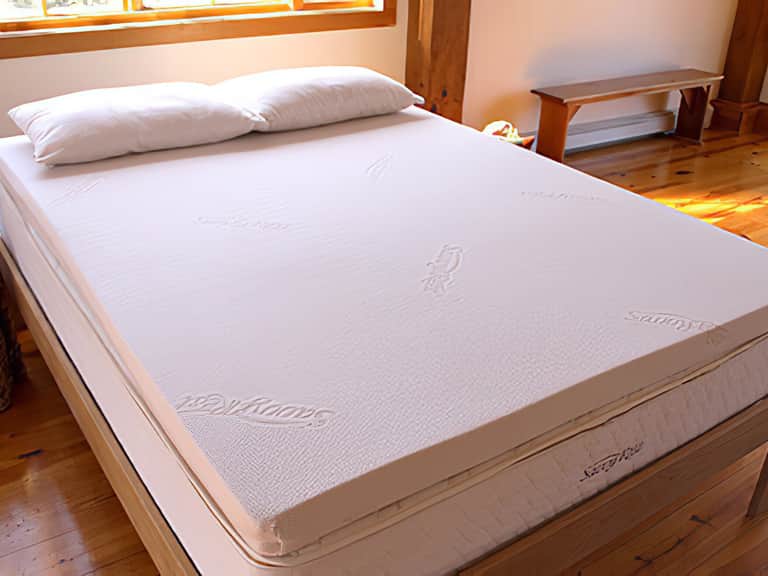
Three inches is one commonly encountered thickness in latex models. For example, the Savvy Rest Vitality Latex Mattress Topper is described as a three-inch layer of soft natural Talalay latex in an organic cotton stretch-knit casing. That product description identifies a substantial softening layer, rather than a barely perceptible surface treatment. Whether it is suitable depends on the mattress underneath and on the sleeper’s preferences; the listed thickness alone cannot predict the outcome.
Think of thickness as the scale of the proposed change. If you like your mattress overall and want only to soften a little, a thick topper could move it farther from the feel you prefer. If the surface is distinctly too firm and in otherwise sound condition, a more substantial layer may be worth considering. When uncertain, compare the available thicknesses in person if possible, or look carefully at return terms before buying. A specification is useful. A night of sleep is more persuasive.
Firmness is not the same as support
Firmness describes the initial impression of a surface: how soft or resistant it seems as you settle onto it. Support is a broader question—whether the bed helps maintain a comfortable, well-aligned position as the body rests. The two are related, but they are not interchangeable. A soft surface may still feel supportive to one sleeper; a firmer surface may be uncomfortable to another. A label cannot account for every body or every mattress beneath it.
In topper shopping, “soft,” “medium,” and “firm” are useful directional terms rather than a universal scale. Manufacturers may describe firmness differently, and the perceived feel changes with body weight, sleeping position, and the mattress below. Someone who lies mostly on their side may experience a surface differently from someone who sleeps on their back. The same latex layer may also feel more yielding over a firm mattress than over a plush one.
A softer topper may be appealing when pressure at the shoulder or hip is the principal complaint. It allows more surface give, which can make the bed feel less unforgiving. But softer is not automatically better. Too much yielding can leave some sleepers feeling insufficiently held, especially if their current mattress already compresses deeply. A firmer topper may preserve a more level, responsive sensation, but it may not provide the extra cushioning a side sleeper is seeking.
It helps to describe the desired outcome rather than chase a firmness term. “I want less pressure at my shoulder but still want to feel lifted” is more informative than “I want a soft topper.” “I want the surface to feel steadier” is more specific than “I need firm.” When shopping, ask how the topper is intended to feel and whether that description assumes a particular kind of mattress beneath it.
Let sleeping position inform the choice
Sleeping position offers a starting point, not a verdict. Side sleepers often pay close attention to pressure at the shoulder and hip, because those areas meet the mattress more directly. A softer or thicker layer may provide additional cushioning, although the right amount depends on the person and the bed. The aim is not to disappear into the surface; it is to find a comfortable balance between give and steadiness.
Back sleepers may be especially attentive to whether a topper changes the sensation across the torso and hips. A layer that is too yielding for a particular sleeper can make the bed feel less even; a very firm layer may not relieve pressure as desired. Stomach sleepers often prefer not to introduce excessive softness, though preferences vary and the construction of the mattress below remains important.
Many people change positions during the night, and some share a bed with someone whose preferences differ. A topper selected for one idealized position may not please a real sleeper who rolls, shifts, or wakes in a different posture. If two people use the same bed, discuss what each wants to change. Pay attention to whether the topper’s fit, size, and construction suit the shared mattress, and remember that a single surface represents a compromise as much as a choice.
Latex construction and the feel of movement
Latex is often chosen for a feel that is responsive rather than slow to recover. When pressure is released, latex tends to spring back, so movement across the surface can feel more buoyant than deeply enveloping. This is one reason people who dislike the sensation of sinking into a material may want to investigate latex. But “responsive” does not mean hard, and “soft” does not necessarily mean slow: firmness and responsiveness describe different qualities.
Latex toppers may be made through different processes, including Talalay and Dunlop. Those terms refer to methods of producing latex, and product construction can vary. It is unwise to infer an exact feel from the process name alone. Firmness, thickness, formulation, cover, and the bed underneath also shape the result. When comparing models, use the manufacturer’s specific description and, where available, test the actual product rather than treating a construction label as a complete forecast.
The feel of latex also differs from that of a topper whose material conforms more slowly. A latex surface may respond more immediately as you shift position. Some sleepers value that ease of movement; others prefer a more enveloping sensation. Neither response is a measure of quality by itself. It is a matter of which kind of surface lets you settle without noticing the surface all night.
Durability is another consideration, though no material is immune to wear. Longevity depends on construction, use, care, and the condition of the mattress beneath. Before buying, review the product’s warranty and any exclusions, and consider whether the manufacturer provides guidance on rotation, cleaning, or storage. A confident-sounding claim about durability should not substitute for the actual care instructions and warranty terms.
The cover, the mattress, and the room
A topper’s cover is more than a finishing detail. It affects how the layer fits, how it feels under bedding, and how it should be cared for. A stretchy cover may allow the material beneath to contour more directly; a less flexible fabric can change the surface impression. Confirm whether a cover is included, whether it is removable, and whether it can be washed. A latex core and its cover may have different care requirements.
Check the dimensions against the mattress, not merely the size name. Measure length, width, and, if relevant to the fit of the sheet, the mattress depth. A topper that shifts or bunches can turn a promising adjustment into a nightly nuisance. Consider the fitted sheet as well: adding several inches to the bed’s surface may require deep-pocket sheets or a different bedding arrangement.
Temperature is personal, and bedroom conditions matter. Latex construction is often discussed in terms of responsiveness and breathability, but a topper cannot guarantee a cool night. Sheets, protectors, room temperature, humidity, pajamas, and individual heat sensitivity all contribute. In Knoxville, where seasons can bring different combinations of warmth and humidity, it may be useful to think about bedding as a system rather than attributing every warm night to one layer.
A practical way to evaluate a topper
If you can test a topper in person, spend enough time to notice more than the initial softness. Lie in your usual sleeping position, then shift into another position you commonly use. Pay attention to whether pressure eases, whether movement feels natural, and whether the surface seems to support you evenly. A brief sit at the edge may tell you something about the overall bed, but it is not a substitute for lying down.
If you are shopping online, write down the details before you compare products: the mattress’s age and condition, what feels wrong, your most common sleeping positions, and whether you want a small or substantial change. Then compare thickness, stated firmness, latex construction, cover, dimensions, care, warranty, and return policy. Those details are more useful than a procession of adjectives about luxury.
- Identify the problem. Separate surface discomfort from sagging, broken support, or an unsuitable mattress.
- Choose the scale of change. A thinner topper tends toward a subtler adjustment; a thicker one makes its character more prominent.
- Match firmness to the goal. Consider whether you want more cushioning, a steadier feel, or a balance of the two.
- Account for position and the existing bed. A topper’s feel is shaped by the body resting on it and by the mattress underneath.
- Read the practical terms. Confirm dimensions, care instructions, warranty coverage, and any trial or return conditions.
- Give the change a fair evaluation. Keep notes about comfort over several nights, while following the seller’s stated return requirements.
Care and expectations
Care instructions should be treated as part of the purchase, not as fine print for a future version of yourself. Some toppers are intended to be spot-cleaned rather than laundered; others have a removable cover with its own instructions. Do not assume that a latex core can go in a washing machine, or that a cover can be dried at any temperature. Follow the specific product guidance, use a suitable mattress protector if appropriate, and avoid folding or storing the topper in ways the manufacturer advises against.
A new layer may also feel different at first than it does after several nights. The change can take time to assess, particularly when you are adjusting to a different amount of cushioning. That does not mean every uncomfortable result will improve with patience. If pain or discomfort persists or worsens, a topper is not medical care; consider speaking with a qualified health professional rather than trying to diagnose the problem through bedding alone.
A topper’s best work is often modest. It does not announce itself as a new bed so much as remove a small, persistent objection to the old one. That modesty is also why a purchase deserves careful thought. A layer that is too thick, too soft, or poorly matched to the mattress can magnify the very sensation you hoped to change.
The right feel is the one that fits the whole bed
There is no single best latex topper firmness, just as there is no universally correct mattress feel. The useful choice is the one that responds to a real complaint without creating a new one. Thickness tells you how much the topper may influence the bed; firmness gives a broad indication of its resistance; construction offers clues about responsiveness and recovery. None can be considered apart from the mattress below.
For a subtle softening, begin by looking at thinner options and a clearly stated firmness. For a more noticeable change to a sound but overly firm mattress, a thicker, softer layer may be worth comparing. If the mattress sags or no longer supports you evenly, address that first. In every case, verify fit and care requirements, and treat product descriptions as starting points rather than promises of a particular night’s sleep.
A good bed is not a technical achievement visible from the doorway. It is a surface you stop negotiating with. The purpose of choosing a latex topper is to make that negotiation quieter: less pressure where you feel it, a response you prefer when you move, and a more comfortable relationship with the mattress you already have. The right choice begins not with a claim of perfection, but with a clear account of what you want the bed to do differently.