Mattress materials and care
Reading Naturepedic Labels: Materials, Certifications, and Care
A mattress label is a small document with a large job. It has to describe what is inside an object most people would rather not think about until bedtime, distinguish verified standards from appealing language, and explain how to keep the whole arrangement in useful condition. Reading one well means looking past the broad promise on the carton and asking a more exact question: what, precisely, is true of this model?
Naturepedic products are often discussed in the vocabulary of organic materials and certification. Those terms can be meaningful, but they are not interchangeable, and they do not automatically apply to every mattress, mattress pad, or accessory a company makes. A careful reader treats a product description as a map to the supporting documentation—not as a substitute for it.
The distinction matters. A mattress can contain several materials, assembled in layers, with different rules governing each one. The cotton in a cover may have one certification; the foam or latex inside may have another; the finished product may have been tested to a separate emissions standard. A single word on a product page cannot tell the whole story. The task is to follow the details far enough to understand what is certified, what is merely described, and what care the specific item requires.
This is not an exercise in suspicion for its own sake. Product labels are compressed by necessity. The consumer’s advantage is patience: compare the stated construction with the certificate, then compare both with the care instructions. The result is a clearer picture of the mattress as an object—its components, its limits, and the habits that may help it last.
Begin with the exact model
Before weighing claims, establish which product is under consideration. Brand-level language can be useful orientation, but a company’s general materials policy does not prove that every item in its catalogue has the same construction or certification. Product families may contain different models, firmnesses, heights, covers, and manufacturing specifications. Even two versions with similar names may have distinct materials or documentation.
Record the complete model name and, where available, the size, model year, and version. Keep a copy of the product page or specification sheet at the time of purchase. Labels and online descriptions can change as materials, suppliers, or standards are updated. The documentation that came with the mattress is often more useful than a general overview page when a question arises later about cleaning, rotation, or warranty coverage.
Then look for a component-by-component description. Does the page identify the cover fabric, filling, comfort layers, support core, and fire barrier, if present? Are materials named with enough specificity to distinguish, for example, cotton from organic cotton, or latex from a particular type of latex? A phrase such as “natural materials” may convey a general intention, but it does not tell a reader what percentage of the product is natural, how a material was processed, or whether a third party has verified the claim.
Useful documentation tends to be concrete. It may list materials by layer, identify the relevant certification, and clarify whether the certification applies to a raw material, a component, or the finished product. When the information is missing, the absence is not proof of a problem. It is simply a reason to ask for the product-specific answer rather than infer one from the brand name.
Read the materials list as a construction diagram
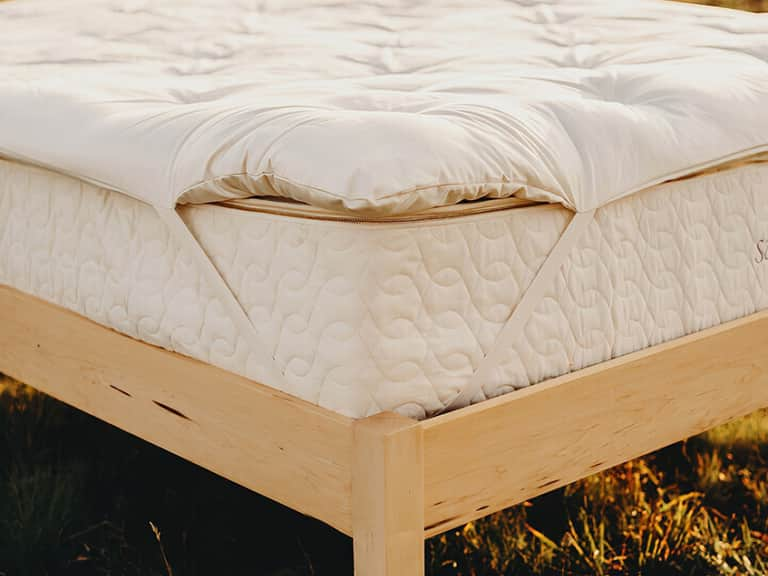
A mattress is less a single substance than a small landscape. A cover encloses one or more comfort layers; beneath them sits a support system, which may be foam, latex, springs, or a combination. Some designs include batting or a barrier layer. Each component has a different role, and each may have its own composition and care considerations.
Read the materials list from the surface inward. First identify the ticking or cover: its fiber content, whether it is removable, and whether it has been treated or blended with other materials. Next, examine the comfort layers. A description may name cotton, wool, latex, or foam, but the name alone does not reveal the amount used or the exact place it occupies in the construction. Finally, note the support core and any additional barriers or adhesives described in the documentation.
Pay attention to qualifiers. “Made with” does not necessarily mean “made entirely of.” “Organic cotton cover” may refer to the fabric rather than every component in the mattress. “Natural latex” is a broad description, while a specification may provide more detail about the latex type and the standard used to verify it. The reader need not become a materials engineer; the point is to know what a claim refers to.
Construction details also help with practical questions. A thick mattress may need deeper sheets. A one-sided design may have different rotation guidance from a flippable model. A cover that is not removable should not be treated as a washable slipcover. These are not obscure technicalities. They determine whether the bed fits the frame, whether the sheets stay put, and whether a well-meant cleaning effort becomes an expensive mistake.
When a description uses broad terms such as “eco-friendly,” “clean,” or “chemical-free,” look for an explanation. “Chemical-free” is not a literal description of a physical product, since all materials are made of chemicals in the scientific sense. More useful language identifies a standard, a test, a material, or a specific practice. The more precise the statement, the easier it is to evaluate.
What certifications can—and cannot—tell you
Certifications are most helpful when a reader knows their scope. A certification is not a general halo cast over a brand. It is a standard applied to defined materials or products, assessed through a particular process. The name of the certifier, the version of the standard, and the item covered all matter.
For textiles, the Global Organic Textile Standard, commonly known as GOTS, is associated with organic fibers and specified requirements across textile processing. A product description may state that a fabric or textile component is GOTS certified, but readers should check whether the claim covers the finished product or a particular component. The certificate or product documentation should make the scope clearer.
For latex, the Global Organic Latex Standard, or GOLS, is a standard that may be relevant to organic latex materials. As with textile claims, the key is to determine what material is covered and whether the certification applies to the latex component, the finished item, or both. A mattress that includes a certified component may still contain other materials governed by different standards.
Other marks may concern emissions, restricted substances, or a product’s broader health and environmental criteria. Their purposes are not identical. A low-emissions certification, for instance, addresses a different question from an organic-fiber standard. Neither should be casually substituted for the other in a buyer’s mind. If a label says that a product has been tested, find out what was tested, against which standard, and by whom.
Look for a certificate number, a current listing, or a link to the certifier’s own directory where available. A logo printed on packaging is a starting point, not the end of the inquiry. It is reasonable to ask whether a certificate is current and whether it covers the model being purchased. If a retailer’s description is more expansive than the manufacturer’s product documentation, compare the wording carefully before relying on either version.
Certification does not answer every question a sleeper might have. It does not guarantee comfort, a particular lifespan, or suitability for every body or sleeping position. Nor does the presence of one certified material automatically establish the status of the entire mattress. These marks are tools for understanding defined attributes; they are not a replacement for considering fit, construction, maintenance, and the terms of sale.
Separate evidence from atmosphere
Mattress descriptions are written in a marketplace that understands the appeal of reassurance. Words such as “pure,” “healthy,” “natural,” and “sustainable” can sound like conclusions, although they may be only introductions. A label reader can translate this atmosphere into questions that have answers.
- Which exact material does the statement describe?
- Is the claim supported by a named standard, a test result, or a detailed specification?
- Does the evidence apply to the finished mattress or only to one component?
- Is the documentation for this model and size, rather than for the brand generally?
- Does the product page distinguish certified content from other components?
It is also worth distinguishing between a material description and a performance promise. “Wool filling” identifies a material; “keeps you cool all night” suggests an outcome that may vary with room temperature, bedding, sleepwear, and the individual sleeper. A manufacturer may have a reasonable basis for describing a material’s properties, but a broad sentence should not be mistaken for a guarantee of personal experience.
This is where a little restraint serves the buyer. The most trustworthy description is not necessarily the one with the most badges or the grandest vocabulary. It is the one that says what is present, identifies the relevant standard, defines its scope, and makes the documentation easy to find.
Care instructions are part of the product
After the materials and certifications comes the less glamorous question of care. A mattress is not a garment; many covers cannot be removed and laundered, and a cleaning method suitable for one surface may damage another. The manufacturer’s instructions for the exact product should take priority over general advice, a tip from a friend, or the confident suggestion of a cleaning product’s label.
Begin with the care booklet, hangtag, or model-specific page. Note whether spot cleaning is permitted, which cleaners should be avoided, and whether water, steam, or dry-cleaning methods are prohibited. If a cover is removable, check whether removal is intended for washing or only for service. A zipper can invite experimentation, but it does not by itself mean the cover is machine washable.
When a small spill occurs, act according to the product guidance and avoid saturating the mattress. Moisture can remain trapped inside a thick construction even after the surface feels dry. If the instructions permit spot cleaning, use the stated method and allow the area to dry thoroughly before making the bed. When the directions are unclear, contact the manufacturer rather than improvise with bleach, solvents, steam, or a household appliance.
Rotation is another instruction that should be model-specific. Some mattresses are designed to be rotated periodically; others may not require it, and some designs are not intended to be flipped. The presence of a label saying “rotate” is more useful than a generic calendar rule. If the product documentation gives a schedule, follow that schedule; if it does not, seek clarification rather than assuming that every mattress benefits from the same treatment.
Keep the warranty document with the care instructions. Warranty terms can describe required support, acceptable use, and maintenance expectations. They are not a promise that ordinary wear will never occur, and they should not be confused with a comfort trial or return policy. Reading these documents before a problem arises is considerably more pleasant than attempting to reconstruct them after the bed has been in use for several years.
A protector, a platform, and some air
A suitable mattress protector can help shield the sleep surface from perspiration, spills, and everyday soil. “Suitable” matters. The protector should fit the mattress dimensions and depth without pulling tightly enough to change the feel or strain the cover. Its own care label deserves a reading, too: a protector that is washed incorrectly may shrink, lose its fit, or cease to perform as intended.
Consider the protector’s material and construction in relation to the mattress. Some protectors are designed to resist liquid; others emphasize breathability or a lighter hand. No protector is a substitute for following the mattress maker’s maintenance guidance, and not every surface treatment behaves the same way under an added layer. If the mattress documentation specifies a type of protector or warns against particular coverings, that advice should guide the choice.
Support underneath the mattress is equally unromantic and equally consequential. Use a frame or foundation that meets the manufacturer’s requirements for spacing, support, and load. A mattress placed on an unsuitable base may sag or receive uneven support, and a warranty may specify what foundation is acceptable. Check the instructions before assuming that a familiar bed frame is compatible with a new model.
Ventilation is a simple part of household maintenance. Allowing bedding to air out when practical and keeping the mattress on an appropriate, ventilated support can help avoid trapping moisture. This does not mean that a mattress should be exposed to direct sun or treated with a home remedy; it means avoiding needless dampness and following the maker’s guidance for the construction at hand. The sensible approach is modest: keep the sleeping environment dry, use clean bedding, and do not seal the mattress in a way the instructions discourage.
A practical label-reading routine
For shoppers comparing organic mattresses, a short routine can prevent a long detour through marketing language. Start by writing down the complete model and the features that matter in daily use: size, height, firmness options, and whether the design is one-sided or flippable. Then build a materials list from the product documentation, layer by layer.
Next, make a separate list of certification claims. For each one, note the certifier, the standard, the material or product covered, and where the supporting evidence can be verified. If the description does not say whether a mark applies to the whole mattress or only a component, ask. A clear answer should identify the scope without requiring the customer to interpret a collection of logos.
Finally, read the care and warranty documents before purchase. Confirm the permitted foundation, whether rotation is recommended, what cleaning methods are allowed, and whether a protector is advised. Save the product specification and any certificate details with the receipt. This small file can be useful for future care, a warranty question, or simply remembering what the mattress is made of after the packaging has long disappeared.
Questions worth putting to a retailer or manufacturer include:
- Can you provide the material breakdown for this exact model?
- Which components are covered by each certification?
- Can I verify the certificate through the issuing organization?
- Is the cover removable, and what cleaning methods are permitted?
- Does the mattress need to be rotated, and is it designed to be flipped?
- What support system and spacing does the manufacturer require?
These questions are not adversarial. They are the ordinary questions a person might ask about an object expected to occupy a room for years. A retailer who can answer them clearly makes the decision easier; a manufacturer’s precise documentation is more useful than a general assurance.
Comfort remains personal
Materials and certifications are important parts of a mattress decision, but they do not settle the matter of comfort. The same construction can feel different to people with different body shapes, sleeping positions, preferences, and sensitivities. Labels can describe the materials with admirable precision and still be unable to predict whether a particular sleeper will enjoy the surface.
When testing a mattress in person, spend enough time in the position in which you usually sleep. Notice whether the surface feels supportive and whether pressure builds at the shoulders or hips. If shopping remotely, read the trial, exchange, and return terms with the same care given to certification details. A trial period is a commercial policy, not a material standard; its conditions can include fees, minimum-use periods, or other requirements.
For people with health concerns, allergies, or specific sensitivities, broad product language should not be treated as medical advice. Ask the manufacturer for relevant material information and discuss health questions with an appropriate clinician. Certification can help clarify defined production or testing criteria, but it cannot establish how every individual will respond to a product.
The quiet value of specificity
Reading a Naturepedic label—or any mattress label—well is less about discovering a secret than resisting the urge to stop at the first reassuring phrase. The useful details are usually modest: a fiber content, a layer description, a standard number, a care restriction, a foundation requirement. Together, they tell a more complete story than a slogan can.
Look for the exact model, the exact materials, and the exact scope of each certification. Keep certification claims distinct from comfort claims. Follow the maintenance instructions supplied for the product in front of you, use a compatible protector if appropriate, and provide the support and ventilation the manufacturer recommends. When a description leaves an important gap, ask for documentation rather than filling it with assumptions.
A mattress spends most of its life out of sight, beneath sheets and blankets. Its label is one of the few moments when the construction becomes legible. A careful reading does not make the choice perfectly predictable, but it replaces vague confidence with specific knowledge—and gives the mattress a better chance of being cared for as the particular object it is.